


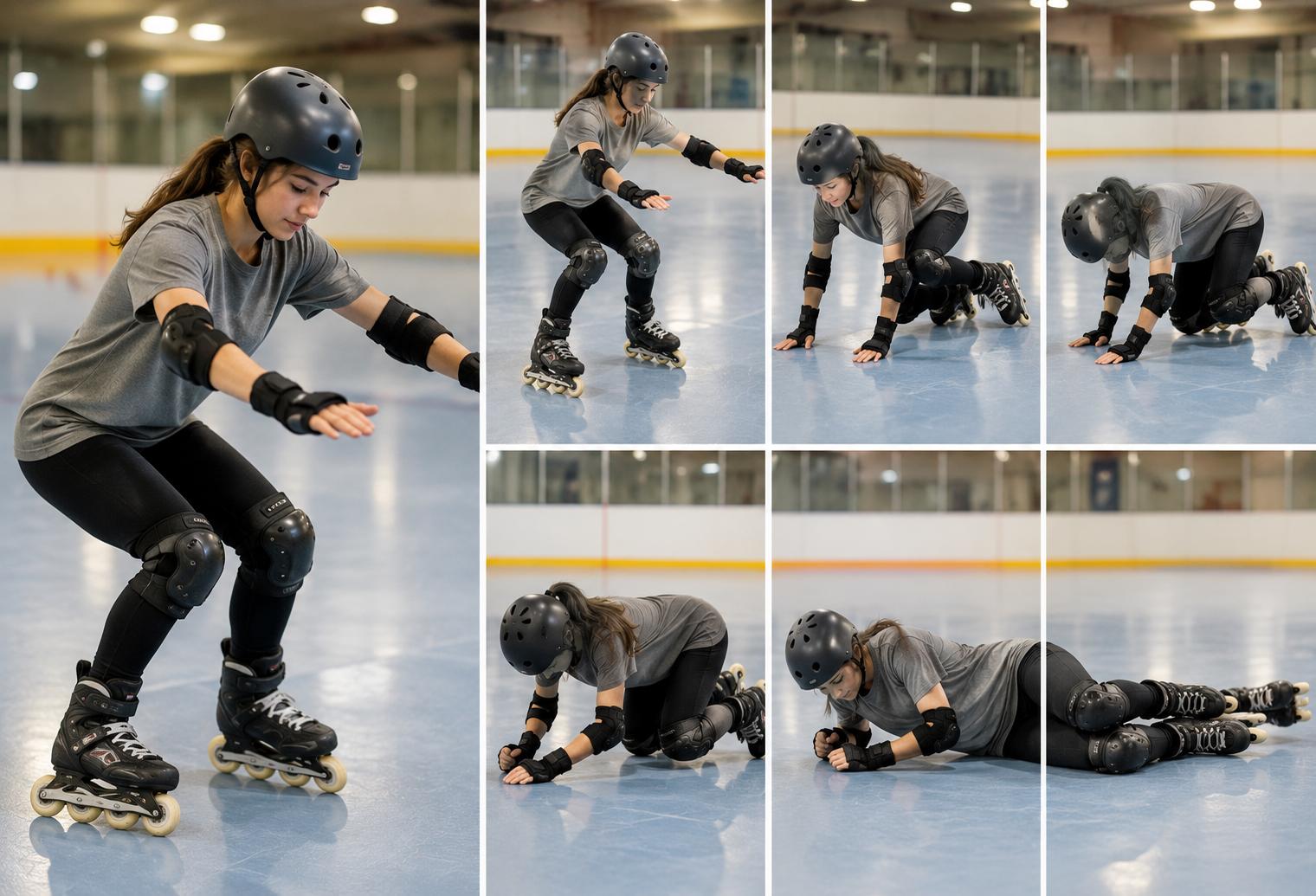
Quick answer: When you feel yourself starting to fall on roller skates, bend your knees, lower your center of gravity, avoid locking your arms straight in front of you, and try to land on a more padded part of your body rather than directly on your hands, elbows, knees, or tailbone. Staying relaxed and keeping your body low generally gives you more control than stiffening up.
What local skaters should know
-
Bending your knees before you lose balance can make a fall shorter and easier to control.
-
Indoor skating gives Liberty beginners a consistent surface where they can practice balance without dealing with rain, snow, uneven pavement, or outdoor debris.
-
Falling is part of learning for children, teens, and adults, so practicing the correct response can be just as useful as practicing forward skating.
-
Beginners from Liberty, Clay County, and the Kansas City Northland should focus on balance and stopping before trying to skate faster.
-
Protective equipment can add another layer of protection, particularly for skaters who are still developing balance.
Why Does Learning to Fall Correctly Matter for Liberty Skaters?
Learning to fall correctly matters because a controlled fall can help reduce the force placed on vulnerable areas such as the wrists, elbows, knees, and tailbone. Beginners in Liberty are often focused on staying upright, but knowing what to do when balance is lost is an important part of developing overall skating skills.
Northland Rolladium Skate Center welcomes skaters in Liberty, MO who are developing their abilities on wheels. At our rink, learning the fundamentals can help beginners become more comfortable before they start working on greater speed or more advanced skating skills.
For local families, indoor skating also offers a controlled alternative to learning outdoors. Missouri weather can bring hot, humid summer days, cold winter conditions, rain, and other changes that affect outdoor surfaces. A consistent indoor skating surface allows beginners to concentrate more fully on balance and technique.
What Is the Safest Position When You Start to Lose Your Balance?
The safest response when you begin losing your balance is usually to get lower by bending your knees instead of becoming stiff and standing taller. Lowering your body shortens the distance you may fall and can give you another chance to regain control before reaching the floor.
Think about bringing your body closer to a squat rather than throwing your arms outward.
When beginners panic, they often straighten their legs and become rigid. That raises the body's center of gravity and can make recovering balance harder.
Instead:
-
Bend your knees.
-
Keep your body low.
-
Stay as relaxed as possible.
-
Avoid reaching toward the floor with locked arms.
-
Try to direct the fall toward a more padded area rather than a joint.
These habits take practice, which is why beginners should work on them before trying to increase their speed.
Should You Catch Yourself With Your Hands?
You should generally avoid trying to stop your entire fall with straight, locked arms because doing so can transfer much of the impact directly into your hands and wrists. A beginner's natural reaction may be to reach immediately for the floor, but learning a different response can help create a more controlled landing.
This does not mean your hands can never touch the floor during a fall. The key is avoiding the instinct to straighten both arms rigidly and use them as the primary brakes for your body.
For young skaters from neighborhoods around Liberty, Claywoods, Shoal Creek, and the Historic Liberty Square area, practicing how to bend low before falling can help replace that automatic stiff-arm reaction with a calmer response.
Should You Fall Forward or Backward on Roller Skates?
A controlled fall toward a padded side or forward position is generally preferable to falling stiffly backward onto the tailbone or reaching backward with straight arms. The exact direction of a fall cannot always be controlled, so the bigger priority is staying low, keeping joints from locking, and avoiding a rigid landing.
Backward falls can surprise beginners because the skates may roll forward while the upper body moves behind them.
Keeping your knees bent while skating helps prevent this. A slight athletic stance places you in a better position to respond if your wheels move unexpectedly.
If you feel yourself tipping backward, try to lower your body instead of standing upright and fighting the movement.
What Warning Signs Show That a Beginner Needs More Balance Practice?
A beginner may need additional balance practice if they repeatedly stand with locked knees, grab nearby people, look directly at their feet, or lose control whenever their speed increases. These behaviors are common during the learning process, but they are signs that strengthening basic skating habits should come before going faster.
Watch for these common signs:
-
Skating with completely straight legs
-
Reaching for walls, rails, or other skaters whenever balance shifts
-
Looking down at the skates instead of ahead
-
Allowing the feet to roll too far apart
-
Moving faster than the skater can comfortably stop
-
Stiffening the entire body when nervous
-
Frequently falling backward
-
Struggling to slow down before other skaters
Beginners from Liberty and surrounding Clay County communities should not feel pressured to match the pace of more experienced skaters. Control comes first.
When Should a Beginner Ask for Skating Instruction?
A beginner should consider skating instruction when they are uncomfortable balancing independently, do not know how to stop, repeatedly fall in the same way, or want structured help developing correct habits. Learning foundational skills with instruction can help prevent beginners from reinforcing techniques that make skating harder.
Our Learn to Skate instruction is designed to help beginners develop fundamentals such as balance and safe falling before progressing to additional skating skills.
That can be especially useful for a child preparing for a birthday skating party, an adult returning to skating after many years, or someone from the Kansas City Northland trying roller skating for the first time.
What Common Mistakes Make Falls Harder?
The most common falling mistakes include locking the knees, skating beyond your ability, grabbing another person, and trying to catch the entire body with straight arms. Each reaction can make an already unstable situation more difficult to control.
Mistake: Standing with straight knees
Consequence: Your center of gravity stays higher, giving you less room to recover.
Better approach: Maintain a comfortable bend in your knees while skating.
Mistake: Reaching for another skater
Consequence: You may pull both people off balance.
Better approach: Lower your body and focus on controlling your own fall.
Mistake: Speeding up before learning to stop
Consequence: Small balance problems become harder to correct.
Better approach: Build control at a comfortable pace first.
Mistake: Staring at your feet
Consequence: Your posture can become less stable and you may not see what is ahead.
Better approach: Keep your eyes forward while maintaining awareness of nearby skaters.
Mistake: Becoming rigid when losing balance
Consequence: A stiff body has less ability to absorb movement naturally.
Better approach: Bend your knees and stay as relaxed as you can.
How Can Beginners Practice Falling More Safely?
Beginners can practice safer falling by first learning the movement slowly and under appropriate supervision rather than waiting until an unexpected fall happens at full skating speed. The purpose is to build a reaction that becomes more natural when balance is actually lost.
Start by practicing the skating stance: feet comfortably positioned, knees bent, upper body relaxed, and eyes looking ahead.
From there, work on getting lower quickly when balance begins to disappear. Beginners should practice at very low speeds and give themselves plenty of space from other skaters.
Parents should also avoid pushing children to skate faster simply because they have completed a few successful laps. A skater who can move forward but cannot reliably slow down, stop, or recover from a wobble is still developing the fundamentals.
What Can Liberty Beginners Expect as Their Skating Improves?
Liberty beginners can expect better balance, smoother movement, and greater confidence as fundamental skills become more familiar, although progress happens at different rates for every skater. Learning how to respond to a fall is one part of becoming comfortable on skates rather than something that should create embarrassment or frustration.
Early practice may involve short periods of skating followed by breaks. Over time, many beginners become less tense and stop concentrating on every individual movement.
The goal is controlled progress.
A skater who feels comfortable moving slowly, stopping, maintaining bent knees, and recovering from small balance changes has a stronger foundation for learning additional skills.
A Common Liberty Beginner Skating Scenario
A common Liberty beginner scenario is a child or adult stepping onto the rink and immediately trying to stand completely upright because that position feels natural off skates. Once the wheels begin moving, however, the skater becomes stiff, reaches for someone nearby, and has difficulty adjusting to changes in balance.
The better approach is to start low and relaxed.
Before worrying about completing a full lap, the beginner can practice bending the knees, looking ahead, taking controlled movements, and learning what to do when balance starts shifting.
That foundation can make future visits to the rink more enjoyable, whether the skater comes from central Liberty, Gladstone, Kearney, or elsewhere in the Northland.
What Skating Options Can Help Beginners Build Their Skills?
Beginner skating options should focus on instruction and controlled practice before advanced techniques or higher speeds. Lessons provide more structure, while public skating can provide opportunities to reinforce skills once a beginner understands how to balance, move, slow down, and fall more safely.
At Northland Rolladium Skate Center, our goal is to help local skaters become more comfortable on wheels while building skills progressively.
Explore Learn to Skate options and start building stronger skating fundamentals
Is Learning on Your Own or Taking Lessons Better?
Learning independently can work for some skaters, but structured instruction is usually more useful when a beginner is unsure about balance, stopping, falling, or basic skating position. Casual practice lets skaters repeat what they already know, while instruction can help identify habits that may otherwise go unnoticed.
For someone who already has basic balance, public skating may provide valuable practice.
For someone who repeatedly falls backward, cannot stop comfortably, or feels too nervous to leave the edge of the rink, instruction may provide a clearer path forward.
Neither option eliminates the need for practice. Good skating develops through repetition.
Where Do Local Skaters Come From?
Our Liberty, MO location serves skaters from throughout the surrounding Northland and Clay County area. Families may visit from nearby communities such as Gladstone and Kearney as well as neighborhoods around Shoal Creek and other parts of the greater Kansas City area.
Indoor roller skating gives area families another recreational option throughout changing Missouri seasons.
What Happens If Beginners Skip Falling and Balance Fundamentals?
Skipping falling and balance fundamentals can make beginners more likely to develop stiff posture, uncontrolled speed, or panic reactions when their wheels move unexpectedly. Those habits can also make learning more advanced skating techniques unnecessarily difficult.
Going faster is not the same as skating better.
Building balance, stopping ability, body position, and safer falling habits first gives beginners a stronger base for future improvement.
Build your skating skills from the ground up with beginner instruction in Liberty
Frequently Asked Questions About Learning to Fall on Roller Skates
Is falling normal when learning to roller skate in Liberty, MO?
Yes. Falling can be a normal part of learning because beginners are adapting to balancing and moving on wheels. Rather than expecting never to fall, new skaters should concentrate on maintaining bent knees, controlling their speed, and learning how to respond when they lose balance.
What should I do first when I feel myself falling?
Bend your knees and lower your body as soon as you feel your balance disappearing. Getting closer to the floor may reduce the distance of the fall and can sometimes help you recover before falling completely. Try not to stiffen your body or immediately lock both arms toward the floor.
Should kids wear protective gear while learning to skate in Liberty?
Protective equipment can provide additional protection for beginner skaters, especially children who are still developing balance and confidence. Parents should choose appropriately fitted equipment based on their child's needs and skating activity. Equipment does not replace learning proper balance, speed control, stopping, and safer falling habits.
Why do beginner roller skaters often fall backward?
Beginners often fall backward when their legs straighten, their skates roll forward, and their upper body remains behind their feet. Keeping the knees bent helps create a more stable skating position. Beginners should practice that posture slowly before increasing speed around the rink.
Can adults take beginner skating lessons in the Liberty area?
Adults can benefit from beginner instruction just as children can, particularly if they have never skated or are returning after a long break. Balance, controlled movement, stopping, and safer falling techniques are useful fundamentals at any age before progressing to faster or more advanced skating.
Is indoor skating easier for beginners than practicing outside in Clay County?
Indoor skating can give beginners a more consistent environment because they do not have to contend with outdoor cracks, gravel, leaves, precipitation, or changing pavement conditions. A predictable surface lets new skaters devote more attention to balance and technique while they become comfortable on wheels.
Should beginners hold onto friends while skating?
Beginners should avoid relying on another moving skater for balance because one person losing control can cause both skaters to fall. It is generally better to develop independent balance at a manageable speed and use appropriate beginner instruction when additional support is needed.
How quickly should a beginner start skating faster?
Beginners should increase speed only after they can comfortably maintain balance, control their direction, and slow or stop. There is no benefit to rushing. For Liberty-area beginners, developing dependable fundamentals during early skating sessions creates a better foundation for more confident skating later.
Learn to Skate With More Confidence in Liberty
Falling does not have to be the part of roller skating that beginners fear most. Learning to bend your knees, stay relaxed, control your speed, and react appropriately when balance disappears can make those first skating experiences feel much more manageable.
Build Better Skating Habits From Your First Lap
At Northland Rolladium Skate Center, we can help Liberty-area beginners focus on the fundamentals that support safer, more confident skating.